The Complete Guide to Ceramic Metering Pumps: Working Principle, Types, and Materials
↓↓↓ Click here to explore our Ceramic Metering Pumps
I. What Is a Ceramic Metering Pump?
II. How Does a Ceramic Pump Work?
III. Types and working principle of Ceramic Metering Pumps
IV. Advantages of Ceramic Metering Pumps
V. Ceramic Metering Pump Materials
VI. Frequently Asked Questions (FAQ)
I. What Is a Ceramic Metering Pump?
1. Ceramic metering pump is a precision positive displacement pump that uses engineering ceramics as its core friction pair components. Its key advantages are high precision, corrosion resistance, and low contamination. It is widely used in industrial and laboratory applications requiring accurate flow control, such as chemical formulation, pharmaceutical filling, and laboratory analysis.
2. Core structure and working principle
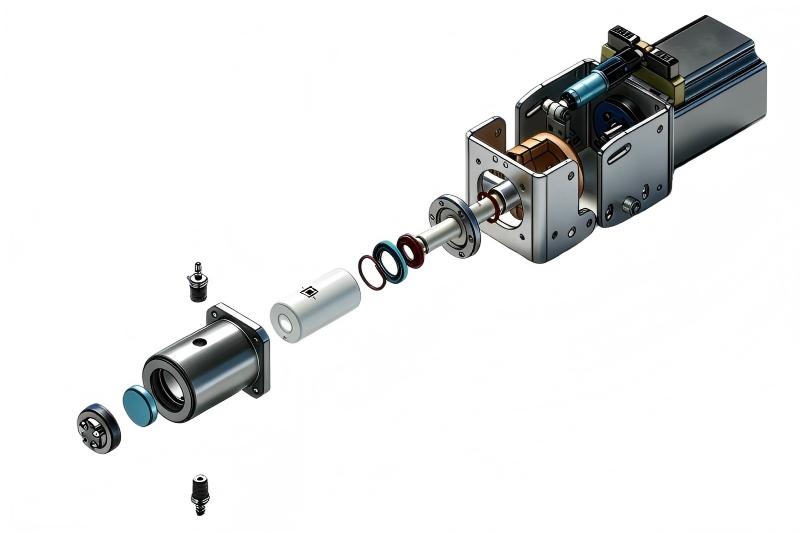
Core components:
(1) Pump sleeve: forms a precision matched cavity with the plunger; it is the fundamental structure that determines the single stroke dispensing volume
(2) Plunger: serves as the actuating element, runing reciprocating motion to achieve precise displacement control; it is highly wear resistance and corrosion resistance
(3) Valve system (or valveless structure)
(4) Drive system
(5) The core friction pair (plunger and cylinder sleeve) is made of alumina ceramic (Al₂O₃, wear resistant) or zirconia ceramic (ZrO₂, impact resistant), avoiding metal contamination.
(6) The drive system typically uses a stepper or servo motor combined with a lead screw, providing precise displacement control to enable reciprocating motion of the plunger, with an accuracy of ±0.1% to ±0.5%.
II. How Does a Ceramic Pump Work?
A ceramic metering pump is a kind of positive displacement precision piston pump. The core friction pair that includes the plunger and the pump sleeve is made of alumina (Al₂O₃) or zirconia (ZrO₂) ceramic with micron level precision fit. It achieves metered suction and discharge of liquid by changing the volume of the pump chamber.
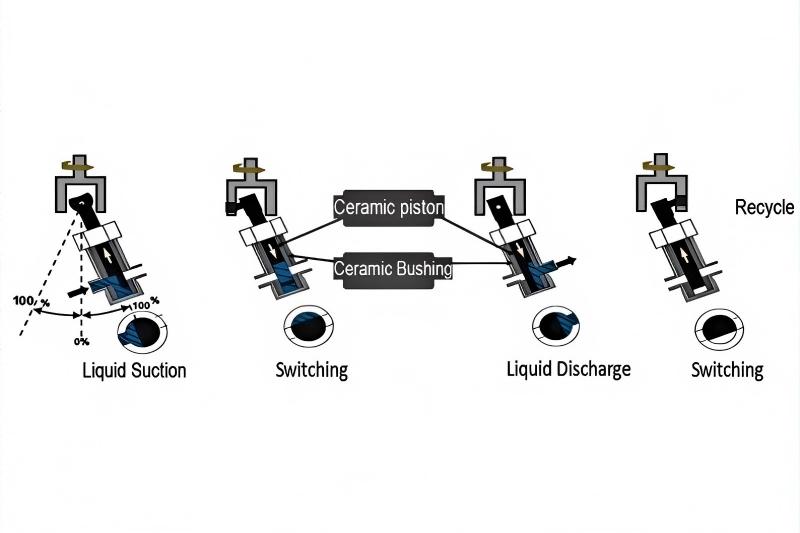
1. Valveless Ceramic Pump
(1) Core components: stepper or servo motor, ceramic plunger (with flow groove), ceramic pump sleeve, inlet, outlet, and a micrometer for angle adjustment.
(2) Full working cycle (plunger rotates + reciprocating motion).
(3) Suction stroke: the motor rotates, and the plunger flow groove aligns with the inlet; the outlet is blocked. The plunger retracts backward, increasing the chamber volume and creating negative pressure, which draws liquid into the pump chamber.
(4) Plunger switching: the plunger rotates so that the flow groove is misaligned with both inlet and outlet, sealing the chamber and locking in a fixed volume of liquid.
(5) Discharge stroke: the plunger continues rotating, and the flow groove aligns with the outlet; the inlet is blocked. The plunger moves forward, reducing the chamber volume, and internal positive pressure pushes out a metered volume of liquid.
(6) The displacement volume per single forward/back stroke determines the dosing volume, with accuracy up to ±0.5%.
2. Check Valve Ceramic Metering Pump
(1) Core components: ceramic plunger, cylinder sleeve, inlet check valve, outlet check valve, and driving mechanism.
(2) Working cycle:
① Suction: the plunger moves backward, creating negative pressure in the cylinder; the outlet check valve closes, the inlet check valve opens, and liquid is drawn into the chamber.
② Discharge: the plunger moves forward, increasing pressure in the cylinder; the inlet check valve closes, the outlet check valve opens, and liquid is discharged.
3. Diaphragm Valve Ceramic Metering Pump
(1) Core components: ceramic plunger, ceramic cylinder sleeve, SMC LVM205R three-way diaphragm valve, precision driving mechanism, and intelligent control system.
(2) Working cycle:
① Suction: the three-way diaphragm valve switches to the suction position, the ceramic plunger moves backward, and a negative pressure is formed in the pump chamber, drawing liquid from the reservoir into the chamber.
② Discharge: the three-way diaphragm valve switches to the discharge position, the ceramic plunger moves forward, the chamber pressure increases, and liquid is transferred from the pump chamber to the outlet end.
4. Constant Flow Pump
(1) Core components: ceramic plunger (ceramic plunger), cylinder sleeve, inlet check valve, outlet check valve, and drive system.
(2) Working cycle: The constant flow pump uses the reciprocating motion of the plunger together with check valves to achieve a periodic suction and discharge process, thereby generating a stable and continuous flow.
(3) Suction stroke:
① The plunger moves backward
② Pump chamber volume increases, creating negative pressure
③ Outlet check valve closes to prevent backflow
④ Inlet check valve opens
⑤ Liquid is drawn into the pump chamber due to pressure difference
(4) Discharge stroke:
① The plunger moves forward
② Pump chamber volume decreases and pressure rises
③ Inlet check valve closes
④ Outlet check valve opens
⑤ Liquid is steadily pushed out of the pump chamber and delivered
(5) Continuous cycling:
① The plunger continuously reciprocates
② Each cycle outputs a fixed volume of liquid
③ Flow rate is adjusted by controlling the drive frequency
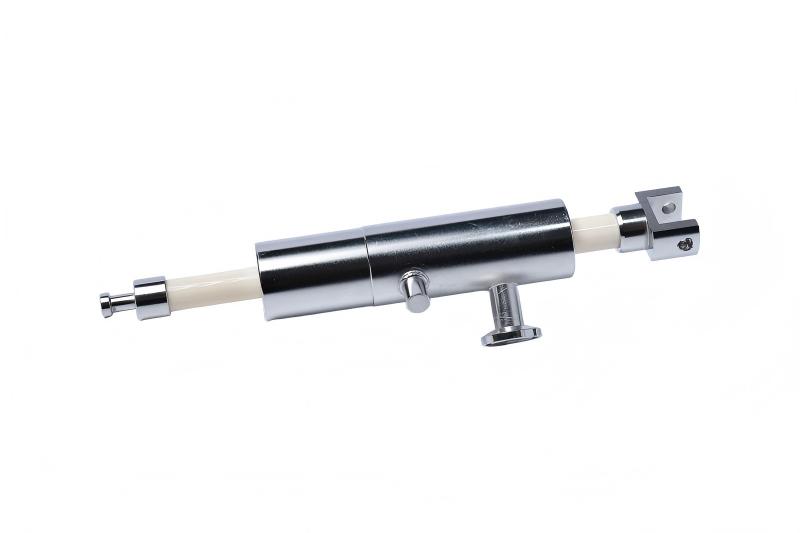
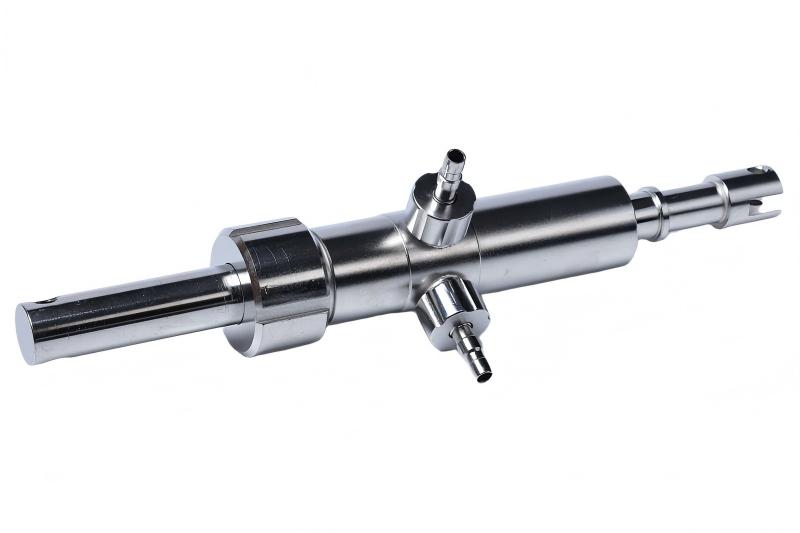
5. Rotary Valve Ceramic Metering Pump
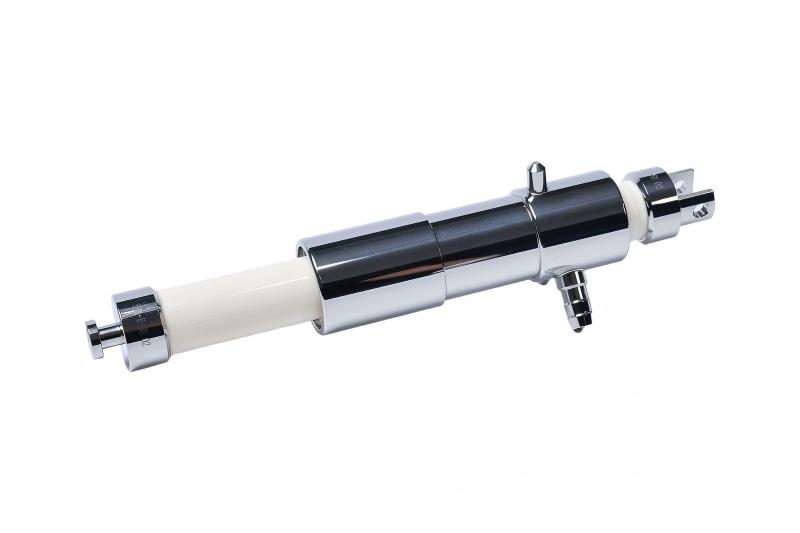
(1) Main Components
A ceramic plunger metering pump with a rotary valve consists of the following components:
① Ceramic Plunger – Creates the pumping action by reciprocating inside the ceramic sleeve to accurately meter liquid.
② Ceramic Sleeve (Pump Sleeve) – Forms a precision hard seal with the plunger, providing excellent wear resistance and long service life.
③ Ceramic Rotary Valve – Switches the flow path between the inlet and outlet ports during each pumping cycle.
④ Pump Housing – Supports and secures the ceramic components while providing fluid connections.
⑤ Drive System – Usually a stepper motor or servo motor that synchronizes the plunger movement with the rotary valve.
(2) Working Cycle
The pump completes one metering cycle through coordinated movement of the ceramic plunger and rotary valve.
Step 1 – Suction The rotary valve aligns with the inlet port while sealing the outlet. As the ceramic plunger retracts, liquid is drawn into the pumping chamber.
Step 2 – Flow Path Switching After the desired volume is aspirated, the rotary valve rotates to close the inlet and connect the pumping chamber to the outlet.
Step 3 – Discharge The ceramic plunger moves forward, forcing the metered liquid through the outlet with high accuracy and repeatability.
Step 4 – Reset The plunger and rotary valve return to their initial positions, ready for the next pumping cycle.
IV. Advantages of Ceramic Metering Pumps
(1) Ultra high dosing accuracy and stability: The ceramic plunger and sleeve have a micron level clearance, achieving accuracy of ±0.1% ~ ±0.5% (up to ±0.005% in high end configurations), with low pulsation (valveless design performs better). Stepper and servo motors with closed loop control ensure strong long term repeatability, suitable for micro and continuous delivery (e.g., chromatography mobile phase, milligram level filling).
(2) Strong corrosion resistance and compatibility: zirconia/alumina/silicon carbide ceramics provide excellent chemical stability, resistant to strong acids, strong alkalis, organic solvents, and corrosive slurries. They are non-reactive with food and pharmaceutical fluids, making them suitable for chemical, pharmaceutical, and battery electrolyte applications.
(3) Wear resistance, long service life, and low maintenance: hardness up to Hv ≥ 1600 (alumina), low friction coefficient with self-lubricating microstructure, no dynamic seals or easily worn parts. Wear is minimal during operation, resulting in a service life far exceeding traditional pumps and near-zero maintenance cost.
(4) Wide operating adaptability: high temperature resistance (up to 200°C), supports vacuum sterilization and online cleaning (CIP), suitable for aseptic production. Compact structure, easy disassembly, and flexible integration with digital control systems (touchscreen / RS485 communication) for convenient installation and commissioning.
(5) Hygeian and contamination-free: inert ceramic materials prevent media contamination, with no risk of lubricant leakage, meeting pharmaceutical and cosmetic cleanliness requirements, offering high cost-performance.
(6) Especially suitable for precision, corrosive, and clean applications, it is an ideal choice for chemical batching, biopharmaceutical filling, and laboratory micro-dosing applications.
V. Ceramic Metering Pump Materials
Ceramic metering pumps are composed of three material categories: core ceramic components, fluid contact components, and structural housing, suitable for different operating conditions:
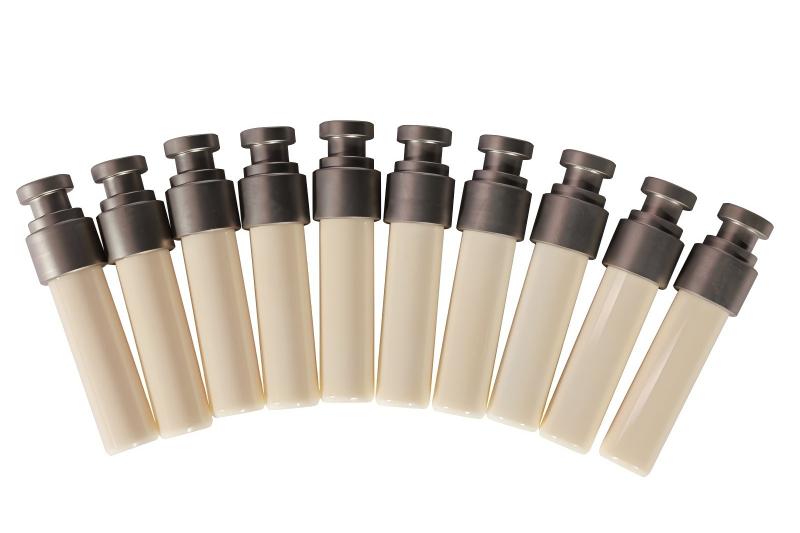
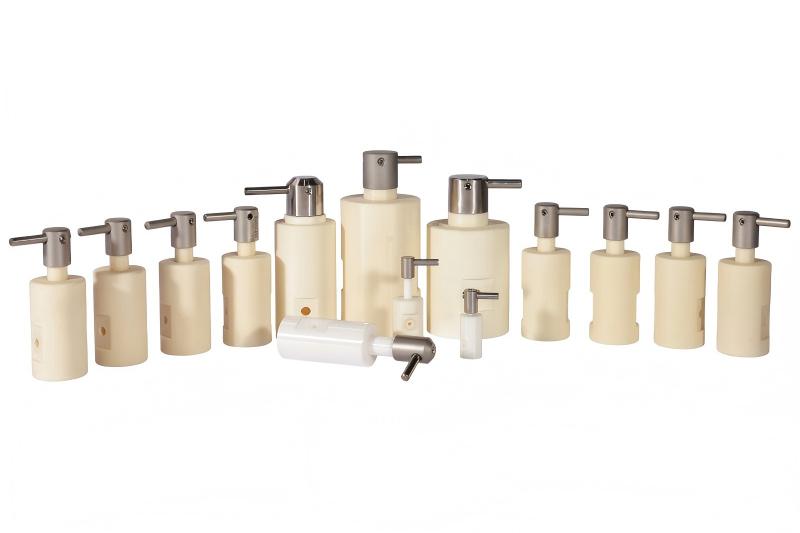
1. Core ceramic components (friction pair)
(1) Alumina ceramic (Al₂O₃): the mainstream material (95% / 99.5% / 99.98% purity), high hardness (Hv ≥ 1600), wear resistant and corrosion resistant. Suitable for acids/alkalis/salts, and clean media in food and pharmaceutical applications.
(2) Zirconia ceramic (ZrO₂): high toughness and strong impact resistance, suitable for high pressure or frequent start-stop conditions (e.g., plunger pumps), balancing wear resistance and fracture resistance.
(3) Silicon carbide (SiC): resistant to strong corrosion (e.g., hydrofluoric acid, fluoroboric acid) and high temperatures (≤200°C), used in highly corrosive environments.
(4) Silicon nitride / monocrystalline alumina: used for special applications; silicon nitride supports ultra-high temperature and pressure conditions, while monocrystalline alumina offers ultra high purity for semiconductor-grade high purity fluids.
2. Wetted Materials
(1) Seals:
PEEK: strong corrosion and high temperature resistance, suitable for strong acids and alkalis
EPDM: general corrosion resistance, cost-effective
PTFE: Teflon, universal chemical resistance, suitable for fluorinated media)
(2) Pump head / valve seat:
PTFE (preferred for strong corrosion resistance)
PP (general corrosion resistance, economical)
316L stainless steel (for high-purity fluids and food/medical applications)
(3) Needles / tubing:
PEEK (precision dispensing)
PTFE (anti-contamination)
SUS316
3. Structural housing
(1) Standard version: 316 stainless steel (high strength, suitable for industrial and food applications).
(2) Full non-metal version: PTFE / PP (corrosion-resistant and electrically insulating, suitable for strong corrosive or metal-free contact environments).
4. Selection depends on the medium (particles / strong corrosion / cleanliness), pressure (zirconia for impact resistance), and temperature (SiC for high temperature). For food and pharmaceutical applications, FDA / RoHS certified materials are required (e.g., high-purity alumina, PEEK).
VI. Frequently Asked Questions (FAQ)
1. What is the accuracy of a ceramic metering pump?
Ceramic metering pumps typically achieve high precision dosing, with accuracy levels up to ±0.5% or better, depending on liquid properties, system configuration, and operating conditions.
For micro-dosing applications (µL level), accuracy can be further optimized with calibration and control systems.
2. Can ceramic metering pumps handle corrosive liquids?
Yes. Ceramic metering pumps are widely used for corrosive and chemically aggressive liquids, including:
(1) Acids
(2) Alkalis
(3) Solvents
(4) Electrolytes
This is due to the high chemical resistance of ceramic materials such as alumina and zirconia.
3. What is the typical flow range of a ceramic metering pump?
Ceramic metering pumps can handle a wide range of flow rates, from:
(1)Microliter level (µL per stroke) for micro-dosing applications
(2)Milliliter level (mL/min or higher) for industrial dosing systems
4. What is the difference between valveless and valve-type ceramic pumps?
(1) Valveless ceramic pumps (e.g., rotary piston type) reduce wear parts and improve long-term stability.
(2) Valve-type pumps use check valves for suction and discharge control, suitable for more general dosing applications.
Valveless designs are preferred for high-precision and low-maintenance applications.
5. Are ceramic metering pumps suitable for continuous operation?
Yes. Ceramic metering pumps are designed for continuous and stable operation, especially in automated production systems such as:
(1) Battery electrolyte filling
(2) IVD reagent dispensing
(3) Chemical processing
6. How long is the service life of a ceramic metering pump?
(1) Service life depends on operating conditions, but ceramic components offer significantly longer wear resistance compared to metal or polymer pumps.
(2) With proper maintenance, the pump can operate for extended cycles with minimal performance degradation.
7. Can ceramic metering pumps handle high-viscosity liquids?
They can handle moderate viscosity liquids, but extremely high-viscosity fluids may require system adjustment or alternative pump selection depending on application requirements.
8. How do I select the right ceramic metering pump?
Key factors include:
(1) Required flow rate
(2) Accuracy requirement
(3) Liquid chemical properties
(4) Viscosity
(5) Automation/control system compatibility
For optimized selection, different pump types (B / Y / G / D series) are recommended based on application.
9. What industries commonly use ceramic metering pumps?
Typical industries include:
(1) IVD diagnostics
(2) Pharmaceutical and biotech
(3) Lithium battery manufacturing
(4) Semiconductor processing
(5) Chemical dosing systems
10. Do ceramic metering pumps require frequent maintenance?
No. One of the key advantages of ceramic pumps is low maintenance requirements due to high wear resistance and stable mechanical structure.
Regular inspection and basic cleaning are usually sufficient.
Need help choosing the right ceramic metering pump? Contact MICRAVA for recommendations.